





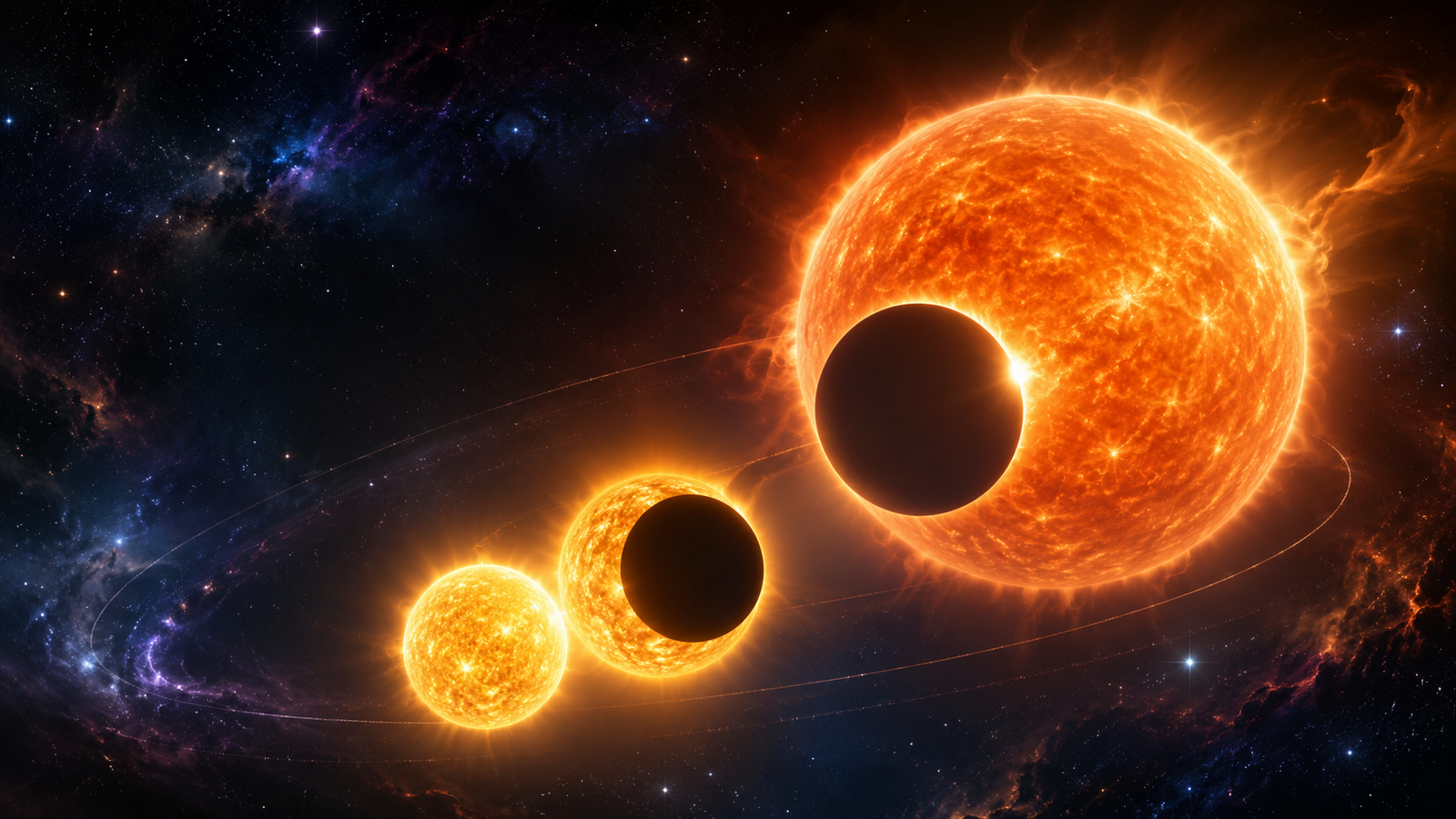
A Star System Where Three Suns Eclipse Each Other
Space is full of strange systems, but every now and then astronomers find something that feels almost cinematic. One such system is TIC 295741342, a rare triple-star system where not one, not two, but all three stars eclipse each other from our point of view on Earth.
This is not just visually fascinating. It gives scientists a powerful natural laboratory to study how stars are born, how they interact, and how they may eventually destroy or transform one another.
TIC 295741342 lies about 3,080 light-years from Earth. It was discovered using data from NASA’s Transiting Exoplanet Survey Satellite, better known as TESS. TESS usually searches for planets by watching for tiny dips in starlight when a planet crosses in front of its star. But in this case, the dips were caused by stars blocking other stars.
And the pattern was extraordinary.
What Makes This Triple-Star System So Rare?
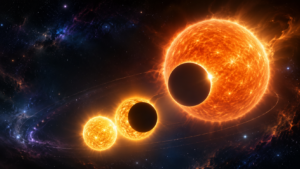
At the center of TIC 295741342 are two stars similar to our Sun. These two stars form a tight binary system, orbiting each other every 4.75 days. Around this pair orbits a much larger third star, a giant star about 1.7 times the mass of the Sun, taking around 412.8 days to complete one orbit.
Triple-star systems are not unusual in the universe. Many stars are born with companions. What makes this system special is its alignment.
All three stars appear to orbit in nearly the same flat plane, and that plane is almost perfectly edge-on from Earth. Because of this rare geometry, we can see the stars pass in front of one another. That creates a triple eclipse pattern that astronomers can measure in great detail.
In simple words: the system is lined up so perfectly that Earth gets a front-row seat to a three-star eclipse show.
The “Head and Shoulders” Eclipse Pattern
When astronomers studied the brightness of TIC 295741342, they saw a very unusual pattern in the light curve.
A light curve is a graph showing how bright an object appears over time. If something passes in front of a star, the brightness dips. In this system, the dips form what scientists describe as a “head-and-shoulders” pattern.
Here is what happens:
First, the two inner stars eclipse each other, producing a smaller dip in brightness. Then the giant outer star moves in front of the binary pair, blocking both stars and creating a deeper dip. Finally, as the stars move out of eclipse, the brightness rises again.
This pattern is important because it helps scientists calculate how much light each star contributes, how large the stars are, how they move, and how the system is arranged.
It is like nature has built a cosmic measuring machine.
A Clue About How the System Was Born
The near-perfect flatness of TIC 295741342 tells scientists something about its origin.
Stars form inside clouds of gas and dust. Sometimes, a rotating disk of material around a young star can break apart into multiple clumps. Those clumps can then collapse into separate stars. This process is called disk fragmentation.
Because the three stars in TIC 295741342 are so closely aligned in the same plane, astronomers suspect they may have formed from the same original disk of material. That would explain why their orbits are so neatly arranged.
Not all triple-star systems form this way. Some may form through gravitational capture, where one star is pulled into orbit around an existing pair. But this system’s smooth alignment strongly hints at a more organized birth from a shared disk.
Could Planets Exist There?
A triple-star system like this naturally raises a fun question: could planets exist there?
The answer is complicated.
The inner binary stars are close together, and the third giant star orbits not extremely far away. That means many planetary orbits would be unstable. A planet too close to the binary could be thrown around by the gravity of the two stars. A planet too far out could be disturbed by the giant third star.
Still, stable planets are not impossible in some triple-star systems. They would likely need to orbit in very specific regions, possibly far from the main gravitational chaos.
If a world or moon did exist in such a system, the sky would be unforgettable. Imagine living under three suns, with changing shadows, shifting daylight, and rare moments when the stars align to create dramatic eclipses.
For most of the time, such a world might experience unusual patterns of light. But during a special alignment, one star could block another, and the system could briefly fall into a strange multi-star twilight.
The Bigger Drama Is Still Ahead
TIC 295741342 is not just interesting because of what it is doing now. It is also important because of what it may become.
The third star in the system is already evolving. It has swollen into a giant phase, meaning it is moving beyond the stable stage of life that stars like the Sun spend most of their time in.
As this giant star continues to expand, it may eventually reach a point where its outer layers are no longer fully held by its own gravity. Material could begin flowing toward the inner binary stars. This is called Roche lobe overflow.
What happens after that could be dramatic.
The system may enter a phase of mass transfer, where one star feeds material to the others. It could create a shared envelope of gas around the stars. The inner binary’s orbit could become unstable. Some stars may merge. Material could be thrown into space. Later, the system could even produce explosive nova-like events.
In other words, this quiet-looking point of light may already be carrying the script for a future stellar drama.
Why Astronomers Are Watching Closely
The next major outer eclipse is predicted around September 1, 2026. Astronomers are encouraging follow-up observations around that date because another clear measurement of the eclipse could help refine the model of the system.
That matters because TIC 295741342 is unusually well suited for study. Scientists have TESS light-curve data, spectroscopic measurements, radial velocity data, and models that can reconstruct the movements and properties of all three stars.
Every new observation improves the picture.
For astronomers, this system is not just beautiful. It is useful. It helps answer serious questions about how multiple-star systems form, how they evolve, and what happens when aging stars begin exchanging material with their companions.
Final Thoughts
TIC 295741342 reminds us that the universe is not static. Stars are not just glowing dots. They are moving, aging, pulling, feeding, eclipsing, and sometimes preparing for violent transformations millions of years in the future.
A rare triple eclipse may sound like a visual spectacle, but it is more than that. It is a cosmic clue.
In this one system, astronomers can study birth, alignment, motion, aging, and future destruction — all through the careful reading of starlight.
Three stars. One rare alignment. And a drama still waiting to unfold.